
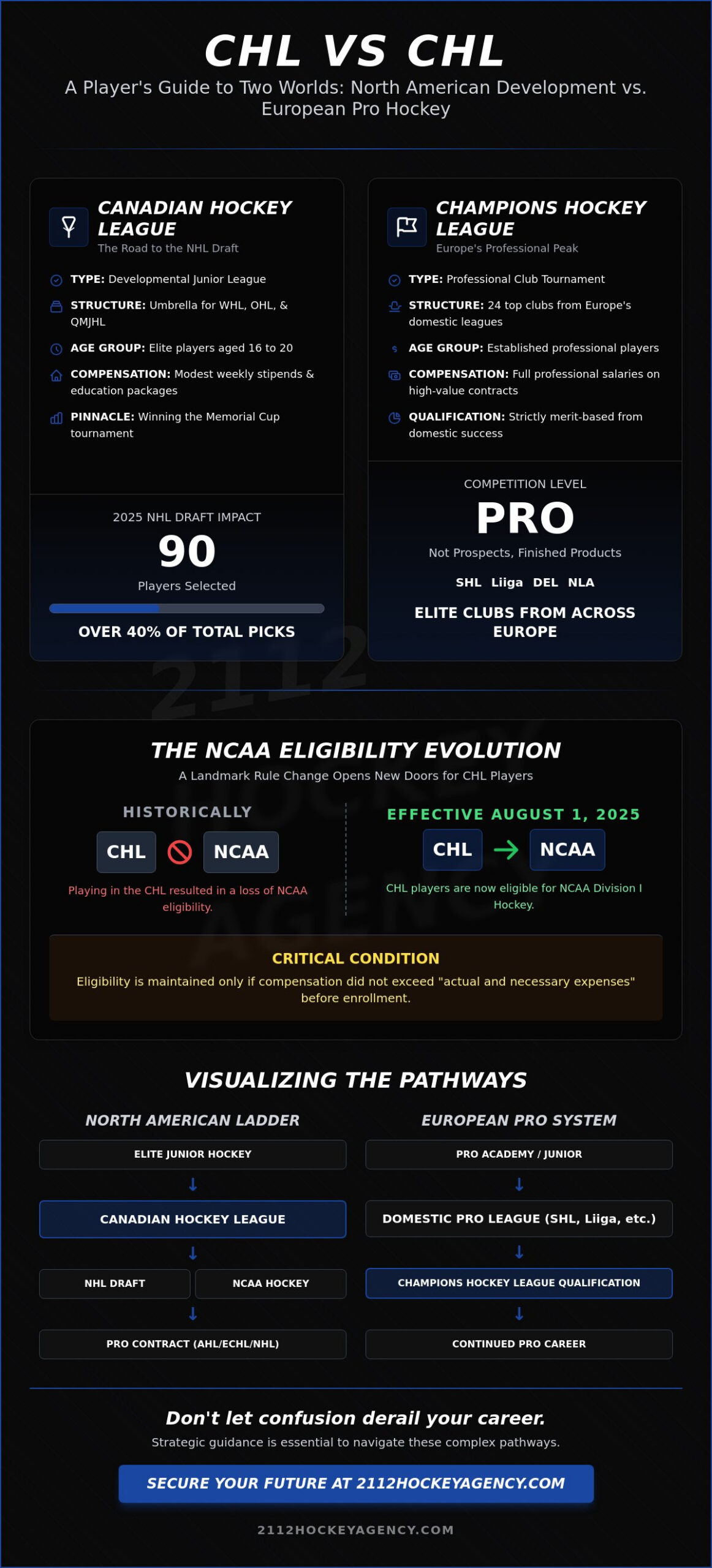
Ninety players from the Canadian Hockey League were selected in the 2025 NHL Draft, accounting for over 40% of the total picks. Despite this dominance, many families and athletes still find themselves asking exactly what is chl hockey league when they start looking at elite pathways. The confusion is understandable. You’re likely balancing the prestige of North American major junior hockey against the high-level competition of the European Champions Hockey League, all while worrying about your future options.
It’s frustrating to feel like one wrong move could cost you a college scholarship or a professional window. We’ll clarify the distinction between these two systems so you can navigate your career with confidence. You’ll learn how the August 2025 NCAA rule change affects major junior players and why the European professional landscape operates on a strictly merit-based qualification. This guide breaks down the professional implications of each path and provides the clarity you need to secure your hockey future.
Key Takeaways
- Differentiate between the North American developmental system and the European professional tournament format to avoid critical career path errors.
- Clarify exactly what is chl hockey league by examining the reality of stipends versus professional salaries in major junior hockey.
- Recognize the European Champions Hockey League as a meritocratic tournament for top-tier professional clubs rather than a traditional season-long league.
- Evaluate the strategic trade-offs between the Canadian major junior route and the NCAA to protect your long-term professional eligibility.
- Identify how professional career management facilitates the transition from elite junior ranks into professional contracts in the AHL, ECHL, or European leagues.
The CHL Identity Crisis: Junior Development vs. European Pro Elite
The acronym “CHL” creates a significant branding overlap that frequently confuses players, parents, and fans. One represents the foundation of North American development; the other signifies the peak of European club competition. Understanding what is chl hockey league requires looking past the letters to the underlying business and athletic structures. These are not branches of a single global organization. They are geographically and operationally separate entities with zero shared governance or unified structure. One focuses on teenagers aiming for the draft, while the other features grown men competing for a continental trophy.
Mistaking a developmental junior league for a professional tournament can derail a player’s career path. The Canadian version is a league where players spend an entire season with one team. The European version is a tournament where professional teams play extra games alongside their regular domestic schedules. This distinction is the first hurdle in strategic career planning. If you don’t know which system you’re looking at, you can’t accurately assess your professional timeline or contract value.
The Canadian Hockey League (Junior Path)
The Canadian Hockey League (CHL) serves as the primary feeder system for the NHL. It acts as an umbrella for three regional circuits: the Western Hockey League (WHL), the Ontario Hockey League (OHL), and the Quebec Maritimes Junior Hockey League (QMJHL). This system caters to elite players aged 16 to 20. Its primary function is high-level instruction and visibility. At the 2025 NHL Draft, 90 players from these leagues were selected, making up over 40% of all drafted athletes. It’s a developmental environment, not a professional career destination.
The Champions Hockey League (European Pro Path)
The European Champions Hockey League is a professional tournament, not a standalone league. For the 2025-26 season, it features 24 teams that qualified based on sporting merit in their own countries. You’ll see elite clubs from the SHL, Liiga, and DEL competing for the title of Europe’s best team. The format includes a regular season starting August 28, 2025, followed by a 16-team playoff. Players in this competition are established professionals on high-value contracts. They aren’t prospects; they are the finished product.
Distinguishing between these paths is critical for effective career management. As of August 1, 2025, Canadian junior players are eligible for NCAA Division I hockey, adding another layer to the decision-making process. Whether you are aiming for the NHL draft or looking to sign your first professional contract in Europe, you must understand what is chl hockey league in the context of your specific goals. Confusing a junior development path with a professional tournament can lead to missed opportunities and lost eligibility.
Myth-Busting the Canadian Hockey League (CHL): Pros or Amateurs?
Many athletes asking what is chl hockey league assume the “Major Junior” label implies a professional contract. It doesn’t. While the environment is elite, players don’t receive traditional salaries. They receive modest weekly stipends for basic expenses and educational packages for post-secondary school. This distinction was the central point of a decades-long debate regarding amateur status. It’s a developmental bridge, not a paid career destination. If you’re looking for a professional paycheck, you’re looking at the wrong CHL.
The league mimics a professional grind with clinical precision. Teams typically play a 68 to 72-game schedule. This includes grueling bus travel across vast provinces and states, nightly media scrums, and high-pressure playoff rounds. The culmination of this effort is the Memorial Cup. It’s a four-team tournament featuring the champions of the WHL, OHL, and QMJHL, plus a host city. It remains the most difficult trophy to win in junior sports because it requires surviving both a regional marathon and a national sprint.
The NCAA Eligibility Evolution
The “NCAA Trap” was once the most feared reality in junior hockey. Historically, playing a single second in the Canadian CHL made you a professional in the eyes of the NCAA, ending your college dreams. This changed on August 1, 2025. Following a landmark vote by the NCAA Division I Council in late 2024, CHL players are now eligible for Division I hockey. However, the rule is specific. You must not have been compensated above actual and necessary expenses before enrolling. Navigating these financial nuances requires career management experts who understand the fine line between a stipend and a professional salary.
Draft Success and the “NHL Factory” Reputation
The “NHL Factory” label is earned through consistent output. At the 2025 NHL Draft, 90 CHL players were selected, making up over 40% of all picks. Scouts prioritize this route because the heavy schedule and high level of competition reveal “pro-readiness” better than any other system. Unlike the Champions Hockey League (Europe), where established pros compete for a continental title, the Canadian circuit is designed to move players into the AHL or ECHL. It’s a proving ground for the next generation of professional talent.
Understanding the Champions Hockey League: Europe’s Professional Peak
The European version of the “CHL” is often a source of confusion for North American players who are used to the junior system. When athletes research what is chl hockey league in a professional context, they must understand that this is a pan-European tournament, not a domestic league. You cannot sign a season-long contract with the Champions Hockey League itself. Instead, you sign with a club in an elite domestic league, such as the SHL in Sweden or Liiga in Finland, which then qualifies for the tournament based on sporting merit.
The 2025-26 season features 24 teams competing in a format that mirrors soccer’s UEFA Champions League. Qualification is strictly performance-based. The reigning champion receives an automatic bid, joined by top teams from six founding leagues and five “challenger leagues.” For a professional, this represents the highest level of club competition outside the NHL. The speed and tactical execution often exceed the AHL, as these rosters are comprised of seasoned internationals and former NHL veterans rather than just prospects. The tournament begins on August 28, 2025, providing an early-season platform for elite competition.
The Prestige of the European Trophy
Winning this tournament provides a massive boost to a player’s professional profile. It’s a showcase of elite talent that draws scouts from every major global league. Because games are played mid-week throughout the winter, they offer a unique platform for players to perform against different styles of play from across the continent. Beyond the prestige, there are tangible financial incentives. Clubs receive participation and performance-based prize money, which often translates into player bonuses. It’s a high-stakes environment where every shift can impact your future scouting reports.
Global Placement and Contract Value
Performing well on this stage directly impacts your marketability. A player who excels in cross-border competition proves they can handle the pressure of high-stakes, international play. This leverage is vital during Professional Contract Negotiations. North American pros frequently prioritize signing with clubs that have secured CHL qualification because it guarantees extra exposure and a more rigorous competitive schedule.
Understanding what is chl hockey league in the European theater is about recognizing it as a career accelerator. It moves you from being a domestic league standout to a recognized continental elite. This distinction is vital for veterans and rising pros who want to maximize their earnings and visibility in the global market. Effective career management involves identifying these opportunities early to ensure your next contract reflects your true value on the international stage.
CHL vs. The Alternatives: Which Path Secures Your Future?
The belief that there’s only one “right” way to reach the NHL is a persistent myth that limits athlete potential. While the Canadian major junior system remains a powerhouse, it isn’t the only viable route. When you’re determining what is chl hockey league in the context of your own career, you have to weigh it against the rising prominence of the NCAA and the “European Bridge” strategy. Some players thrive in the high-volume game schedule of the WHL or OHL, while others require the physical development time offered by the American college system. Choosing the wrong environment can stall your progression during your most critical developmental years.
For elite 18-year-olds who aren’t quite ready for the NHL but have outgrown junior competition, playing professionally in Europe has become a sophisticated alternative. This path allows you to compete against established men in leagues like the SHL or DEL while maintaining high visibility for scouts. To understand where your specific skill set fits within these tiers, review our Professional Hockey: Global Player’s Guide. Identifying the right league early is the difference between a stagnant career and a multi-million dollar contract.
Developmental Speed vs. Educational Security
The Canadian CHL offers the fastest track to the professional grind. With a 72-game schedule and heavy travel, it prepares you for the endurance required in the AHL or NHL. Conversely, the NCAA path provides a lighter game schedule, typically 34 to 40 games, allowing more time for weight room gains and the security of a degree fallback. European professional leagues offer a third way: early exposure to sophisticated tactical systems and “grown-man” strength. Each path has distinct benefits depending on whether you’re a “late bloomer” or a ready-made prospect.
The Role of the NHL Entry Draft
Your league choice directly impacts your draft stock for 2026. While the Canadian system produced 90 drafted players in 2025, scouts are increasingly frequenting NCAA and European professional rinks. The myth of the “hidden” player is dead; if you have the talent, modern scouting networks will find you in any high-level league. The real challenge comes for undrafted 20-year-olds leaving the junior ranks. These overage players must have a calculated placement strategy to transition into the AHL, ECHL, or a European contract without losing momentum.
Success in this industry requires more than just on-ice talent. It demands a strategic partner to handle the complexities of the market. Contact us for expert career management to ensure you’re positioned in the league that maximizes your professional value.
Navigating the CHL Landscape with 2112 Hockey Agency
Deciding between the Canadian major junior system and the NCAA is no longer a one-way street. Since the August 1, 2025, policy shift allowing CHL players into Division I hockey, the decision-making process has become exponentially more complex. We help families evaluate these paths by looking at the athlete’s specific developmental timeline. If you’re still asking what is chl hockey league in terms of its impact on your long-term prospects, you need a partner who understands both the North American and European markets. Our holistic approach to Career Management ensures your decisions today don’t limit your professional contract options tomorrow.
Transitioning out of the junior ranks at age 20 is a high-stakes moment. Overage players often face a “cliff” where they must immediately secure a spot in the AHL, ECHL, or a professional European league. We manage this transition by matching your performance data with teams that need your specific profile. When dealing with European clubs qualified for the professional tournament version of the CHL, professional representation is mandatory. These clubs operate under strict “Import” rules. Navigating those contract nuances requires an agency with deep international connections and a firm grasp of regulatory frameworks.
Contract Negotiation in a Global Market
We leverage your junior statistics to secure favorable professional terms. A high-scoring season in the OHL or WHL is a powerful tool during contract negotiations, but only if presented to the right decision-makers. For those heading to European clubs, we manage the complexities of “Import” status. This includes ensuring your housing, travel, and tax implications are handled correctly within the contract. Additionally, we secure branding and marketing deals for elite junior stars, maximizing your earning potential before you even sign your first pro card.
The Darryl Wolski Advantage
Our agency provides direct access to Darryl Wolski, offering a Winnipeg-based perspective with a massive global reach. We don’t just place players; we build multi-year professional arcs. Our track record includes placing athletes in leagues that match their developmental ceiling, from the NHL to the top tiers of Europe. Stop guessing about your future. Consult with 2112 Hockey Agency for your next career move and take control of your professional trajectory.
Secure Your Professional Future in the Global Market
Understanding what is chl hockey league is only the first step toward a successful career. You now recognize the critical gap between North American developmental paths and the elite European tournament structure. The 2025 NCAA eligibility shift has opened new doors, but it’s also increased the risk of making an uninformed decision. Strategic placement is no longer optional; it’s a requirement for anyone serious about the NHL, AHL, or top European tiers.
Since 1997, 2112 Hockey Agency has provided the specialized expertise needed to navigate these high-stakes transitions. Led by Darryl Wolski, our team focuses on global AHL, ECHL, and European placement to ensure your talent meets the right opportunity. We don’t just find your next game. We manage your multi-year professional arc through disciplined negotiation and proactive career management. Use our experience to stabilize your trajectory and maximize your contract value.
Apply for Professional Representation with 2112 Hockey Agency today. Your potential deserves a partner that works as hard as you do on the ice.
Frequently Asked Questions
Is the CHL considered professional for NCAA eligibility?
CHL players are eligible for NCAA Division I hockey as of August 1, 2025, provided they haven’t received compensation beyond actual and necessary expenses. Previously, the NCAA viewed these athletes as professionals, which barred them from college play. This policy change allows major junior players to maintain their college eligibility while competing at the highest level of North American development.
What is the difference between the WHL, OHL, and QMJHL?
The difference lies primarily in geography and style of play. The Western Hockey League (WHL) covers Western Canada and the U.S. Pacific Northwest; the Ontario Hockey League (OHL) spans Ontario and the Great Lakes region; and the Quebec Maritimes Junior Hockey League (QMJHL) serves Quebec and the Atlantic provinces. While all three fall under the same umbrella, scouts often associate the WHL with size and the OHL with high-end tactical development.
Can American players play in the Canadian Hockey League?
American players can and do play in the Canadian Hockey League. Currently, nine American-based teams compete within the system, primarily in the WHL and OHL. U.S. born athletes often choose this route to experience a professional-style 68 to 72-game schedule and gain maximum exposure to NHL scouts before their draft year.
Do players in the Champions Hockey League get paid?
Players in the Champions Hockey League are paid professional salaries because they are established members of elite European clubs. Since this is a tournament for professional teams in leagues like the SHL and Liiga, participants are under full-time contracts. These athletes receive standard wages, bonuses, and benefits as defined by their domestic club agreements and professional negotiations.
How do I get scouted if I am playing in the CHL?
Scouting occurs through consistent performance in high-leverage situations. NHL scouts attend nearly every game because the league is the primary feeder for the professional ranks. To maximize your visibility, you must perform well during mid-season showcases and playoff runs. Families often ask what is chl hockey league scouting like; it’s a constant, year-round evaluation of your physical and mental maturity.
What happens to a player after they turn 21 in the Canadian CHL?
Once a player turns 21, they graduate from the major junior system and must transition to the professional or collegiate ranks. Most elite overage players seek contracts in the AHL or ECHL, while others move to European professional leagues. If a player chooses not to turn pro, they can utilize the CHL’s educational scholarship package to play for a Canadian university or an NCAA program.
Is the CHL better than the USHL for NHL draft prospects?
Neither league is objectively better; the choice depends on your specific developmental needs. The Canadian system offers a heavier game schedule that mimics the NHL grind, while the USHL is a top-tier amateur league that has historically been the primary feeder for the NCAA. Both leagues produce high-end NHL draft picks every year, so your decision should focus on where you’ll receive the most ice time.
How does the Champions Hockey League tournament format work?
The Champions Hockey League tournament features 24 teams competing in a specialized merit-based format. Each team plays six games against six different opponents in the regular season, followed by a 16-team playoff. The playoffs are two-game, home-and-away series decided by aggregate scoring, culminating in a single-game final. Understanding what is chl hockey league format helps pros prepare for the extra physical demands of their season.