Your forty-goal season in junior hockey doesn’t guarantee you a professional contract. In fact, many high-scoring forwards are passed over every year because their game lacks the “projectable” habits that translate to the faster, heavier pace of pro leagues. It’s frustrating to lead your team in points but still feel invisible to the decision-makers in the stands. If you’re confused about how to stand out in a talent pool that now includes older, more physically mature players due to the 2025-26 NCAA eligibility shifts for CHL athletes, you aren’t alone.
Mastering what scouts look for in a hockey forward requires a shift in focus from the scoresheet to the professional details. You probably already know that your compete level matters, but you need a clear roadmap of the technical and mental traits that actually secure a signature. This checklist breaks down the specific habits pro scouts demand, from off-puck positioning to the “heavy” play required for the 2026 season. We’ll show you how to identify these elite traits to better position yourself for professional contract negotiation and expert career management.
Key Takeaways
- Shift your focus from junior-level point production to “projectable” habits that translate to the faster, heavier pace of professional hockey.
- Identify the three non-negotiable technical skills, including puck protection and elite edge work, required to win battles in the “dirty areas.”
- Understand what scouts look for in a hockey forward regarding off-puck reliability and defensive responsibility to prove you are a low-risk asset.
- Learn the specific physical and mental requirements that separate prospects in the AHL, ECHL, and European professional circuits.
- Discover how professional representation turns a strong scouting report into leverage during contract negotiations and long-term career management.
Beyond the Highlight Reel: Why Pro Scouts Value Projectable Habits
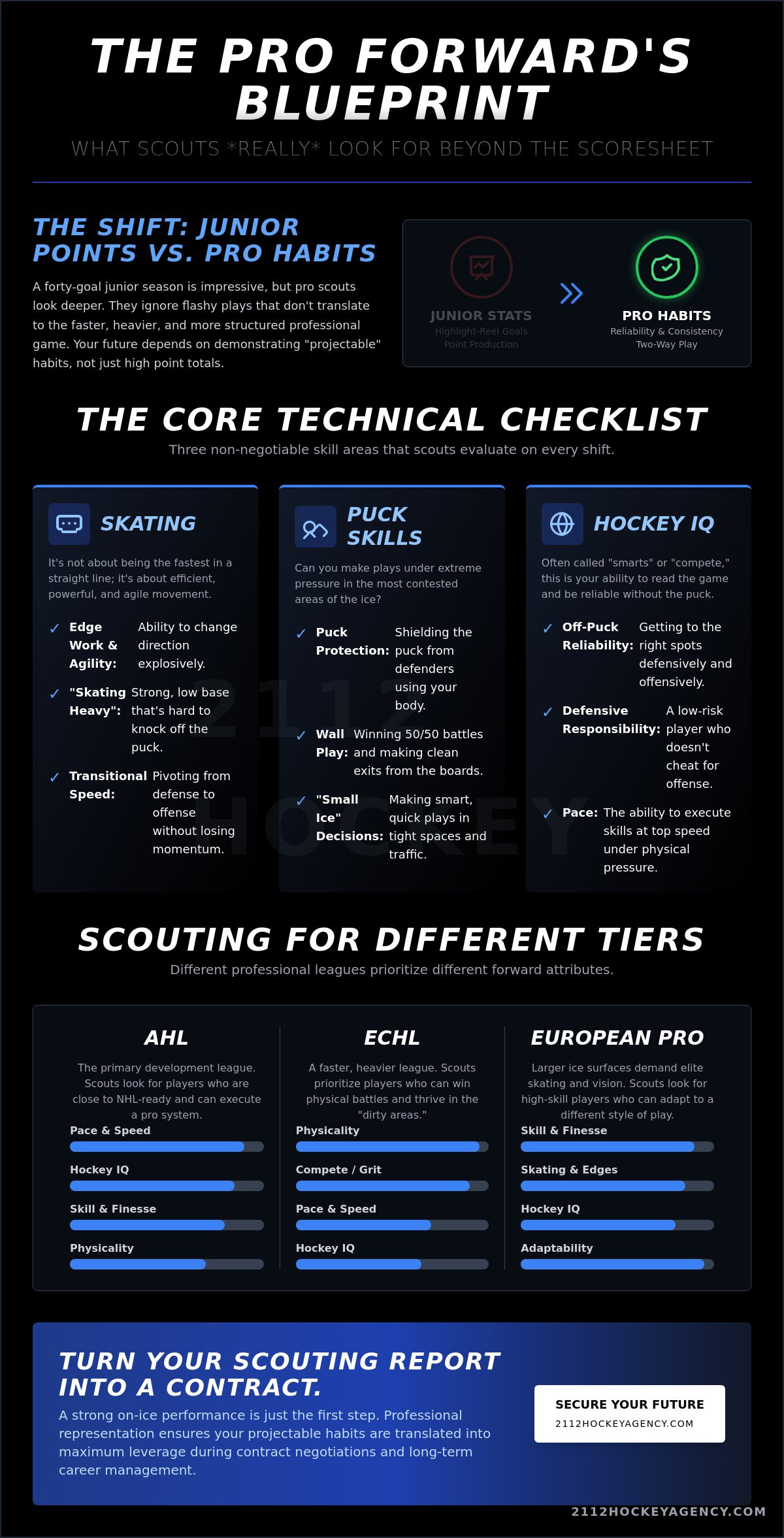
Dominating a U18 or CHL league often relies on physical maturity that levels out once you hit the professional ranks. Scouts ignore the flashy “Michigan” goals if you’re a liability in your own zone. They want to see how your game translates to a faster, heavier environment. This is the foundation of what scouts look for in a hockey forward; they look for projectable habits that survive the jump to the AHL or ECHL. Junior dominance can be deceptive if it’s built on skills that won’t work against 220-pound veteran defenders.
A common mistake is focusing on a high “ceiling” while neglecting your “floor.” Most prospects won’t start their pro careers on the first power-play unit. Pro teams need bottom-six forwards who are reliable, win wall battles, and manage the puck efficiently. If your game is built on over-handling the puck or taking high-risk routes through the middle, scouts see a “Harlem Globetrotter” trap. These fancy moves might look good on social media, but they often lead to turnovers that professional teams capitalize on instantly. Reliability in simple situations is often more valuable than occasional brilliance.
Modern scouting combines the traditional eye test with advanced data. Teams analyze key performance statistics to see if your production is sustainable. They look at puck recovery rates, zone entry success, and defensive positioning metrics. If the data shows you only produce against bottom-tier teams but disappear against elite competition, your scouting report will reflect that lack of consistency. Verification through analytics ensures that a player’s impact on the game is real and not just a product of high ice time or weak opponents.
The Reality of the 2026 Scouting Landscape
The 2026 season has seen a massive shift toward multi-dimensional players. You can’t just be a “scorer” anymore. Scouts prioritize “pace,” which is your ability to execute skills at top speed under physical pressure. Top-end speed is useless if your brain can’t keep up with the play. Character checks are also more rigorous than ever. Teams frequently call former coaches, teachers, and even teammates to ensure you have the discipline required for a professional locker room.
Defining the “Projectable” Forward
A projectable forward has a style that survives heavy contact. Can you maintain puck possession in the ECHL’s “dirty areas”? Do you have the mental maturity to handle a transition to European leagues? Understanding your specific value is part of the long-term process. This is where Professional Contract Negotiation becomes critical. It defines your market value based on these projectable traits rather than just your point totals from the previous season.
The Core Technical Checklist: 3 Non-Negotiable Skills for Forwards
Professional scouts don’t just watch the puck. They watch how you move to get it. When evaluating what scouts look for in a hockey forward, technical proficiency is the baseline. You need more than raw talent; you need tools that function under the extreme pressure of a pro-level forecheck. Many analysts refer to The Four S’s of scouting: Skill, Skating, Smarts, and Speed. These categories provide the framework for your technical development and determine if your game can survive the jump to the next level.
Skating Beyond Straight-Line Speed
Straight-line speed is a track stat, not a hockey stat. Scouts prioritize edge work, lateral agility, and first-step explosiveness. They look for “active feet” in the offensive zone. This means you’re constantly changing lanes to create passing options or defensive confusion. Transitional skating is equally vital. Can you pivot from an F1 backcheck into an offensive transition without losing momentum? Pro teams value “skating heavy,” which refers to a strong, low base that makes you difficult to knock off the puck. It’s about stability and power, not just a high top-end speed.
Puck Skills Under Pressure
Winning battles in the “dirty areas” is a non-negotiable requirement. While some competitors focus only on shooting, scouts prioritize puck protection and wall play. You must handle the puck in “small ice” scenarios where you have less than a second to make a decision. This includes making “pro-level” passes through a forest of sticks and skates. Protecting the puck on the cycle is what prolongs offensive zone time and wears down opposing defenders. If you can’t win a puck battle along the boards in the third period, your offensive stats won’t matter.
Scouts also look for a diverse shot arsenal. It’s not about how hard you hit the glass from the perimeter. They want to see a quick release from high-danger zones, specifically the slot and “home plate” area. Can you change the angle of your blade right before the release? This deception is what beats pro goaltenders. If you lack massive size, your technical execution must be flawless. The “Adam Fox” effect describes players who use superior IQ and skating mechanics to neutralize larger opponents. This level of detail is exactly what we analyze when providing professional career management for our clients. Every technical habit you develop either builds or breaks your case for a professional contract.
The “Compete” Factor: Evaluating Hockey IQ and Off-Puck Reliability
Scouts prioritize a high compete level, but this term is often misinterpreted as simple hustle. In professional circles, “compete” refers to sustained mental intensity and the refusal to be outworked in tactical situations. Understanding what scouts look for in a hockey forward requires looking past the puck-carrier. They want to see situational awareness: do you know the score, the time remaining, and the current momentum? A forward who takes a high-risk gamble at the blue line while protecting a one-goal lead in the third period demonstrates a lack of professional maturity. Scouts aren’t just looking for players who can score; they’re looking for players they can trust.
Emotional discipline is another critical component of the compete factor. Professional hockey is physically punishing and mentally draining. Scouts watch how you react after a missed call or a hard hit. If you take a retaliatory penalty or lose focus because of frustration, you signal that you’re a liability in high-stakes environments. Playing through physical adversity without sacrificing your tactical responsibilities is a hallmark of an elite prospect. This resilience, combined with the ability to be the first player to the “second puck” after a shot or a blocked pass, separates professional-grade forwards from career amateurs.
What Hockey IQ Looks Like to a Scout
Hockey IQ is the ability to process the game faster than your opponents. To a scout, this looks like identifying passing lanes before they even open. It involves positioning yourself away from the puck to draw defenders out of the slot, effectively creating space for your teammates. High-IQ forwards understand the defensive system of the opponent in real-time. They recognize when a defenseman is cheating toward the wall and exploit that gap instantly. This mental processing allows smaller or less explosive players to thrive by simply being in the right place at the right time.
The Importance of the “200-Foot Game”
The quickest way to lose a scout’s interest is to “cheat” for offense. If you’re blowing the zone early or neglecting your F3 responsibilities to hunt for a breakaway, you’re telling the scout you don’t care about winning. Defensive responsibility is non-negotiable. This means backchecking with the same purpose you use on a forecheck. Reliability in the final two minutes of a game is what earns you a professional contract. Effective Career Management helps players refine these “invisible” traits, ensuring that every shift demonstrates a complete, 200-foot commitment to the game.
Scouting for Different Tiers: AHL, ECHL, and European Requirements
Professional hockey is not a monolith. The criteria for what scouts look for in a hockey forward shifts significantly depending on the league’s specific demands and style of play. While technical skills are universal, the application of those skills varies. An AHL scout is looking for “NHL-readiness,” which means your game must be refined enough to step into a major league lineup tomorrow without being a liability. In contrast, ECHL scouts often prioritize physical durability and the mental toughness required to grind through a grueling 72-game schedule with heavy travel. Understanding these nuances is essential for any player looking to climb the ladder.
Geography also dictates scouting priorities. A scout based in Winnipeg might place a higher premium on board play, puck protection, and grit in high-traffic areas. Meanwhile, a scout in Sweden often values puck possession, lateral agility, and the ability to navigate complex tactical systems. These regional preferences mean that a player who is overlooked in North America might be a high-value target for a European club. Matching your specific skill set to the right league is a strategic move that defines a successful professional career.
The North American Pro Path
In the ECHL, scouts often look for the “Everblades style” of play. This refers to a high compete level and a consistent physical presence that wears down opponents over a three-game series. If you want to earn an AHL call-up, you must demonstrate a simple, mistake-free game. AHL coaches don’t need a fourth-liner who tries to beat three defenders at the blue line; they need a reliable forward who finishes checks and executes the defensive system perfectly. Successfully navigating professional hockey league hierarchies requires a clear understanding of your current “floor” and how it fits into a team’s roster needs.
The European Scouting Landscape
European leagues like the DEL in Germany or the SHL in Sweden offer a different environment for “skill forwards.” The larger ice surfaces reward elite skating and tactical discipline over raw physicality. Scouts in these regions look for players who can adapt to puck-possession systems where dumping the puck is often the last resort. Tactical intelligence is the primary currency here. If you can’t read a neutral zone trap or maintain your positioning in a disciplined defensive structure, your offensive talent won’t be enough to keep you on the roster. The value of an agent with global connections is undeniable when managing these international transfers.
Securing a contract in these varied markets requires more than just a good highlight reel. It takes a strategic approach to market yourself to the right teams at the right time. Contact 2112 Hockey Agency today for professional career management that aligns your specific strengths with the global scouting landscape.
Securing the Contract: How 2112 Hockey Agency Navigates the Process
Understanding what scouts look for in a hockey forward is the first step, but translating that knowledge into a signed contract requires a sophisticated approach to career management. A high scouting grade is only as valuable as the leverage it creates during professional contract negotiation. At 2112 Hockey Agency, we bridge the gap between being a “prospect” and becoming a “professional.” We don’t just wait for scouts to find you; we manage the narrative of your development to ensure the right decision-makers are in the building at the right time.
Darryl Wolski leverages over 25 years of industry connections to facilitate these opportunities. This network spans North American pro leagues and the top European circuits. When a scout identifies a specific need for a reliable, 200-foot forward, we ensure our clients are the first names mentioned. We market the “complete athlete,” focusing on the projectable habits and mental maturity that teams prioritize for the 2026 season. This proactive branding ensures that your off-puck reliability and technical consistency are highlighted as primary value propositions.
From Scout Watchlist to Signed Contract
Moving from a watchlist to a contract offer involves navigating the professional recruitment cycle with precision. We handle negative scouting feedback by addressing it directly through targeted career management strategies. If a scout questions your lateral agility or defensive awareness, we work with you to refine those specific areas and demonstrate improvement in subsequent viewings. Timing is everything. Signing too early or waiting too long can cost you significant leverage. Choosing the right hockey agency is the most critical career move you’ll make to ensure these windows of opportunity don’t close prematurely.
Your Professional Future Starts with 2112
Our placement strategies are personalized for every tier of the game. Whether you’re aiming for the AHL call-up path or a lucrative career in the European SHL, we align your strengths with the leagues that value them most. Holistic development is at the core of our philosophy. We provide the mental and physical preparation required to survive the transition from junior ranks to the high-pressure environment of pro life. This includes navigating the modern regulatory frameworks and emerging industry standards of the 2026 landscape. Your career deserves a steady hand and an elite-level network. Contact 2112 Hockey Agency for professional representation and take the next step toward your professional contract.
Take Command of Your Professional Hockey Career
Securing a professional contract in 2026 demands a shift from junior-level flash to elite-level reliability. You’ve learned that projectable habits, such as puck protection and defensive awareness, weigh more heavily in a scout’s notebook than a highlight-reel goal. Mastering what scouts look for in a hockey forward is the essential baseline for any athlete serious about a long-term career. Whether you’re targeting the AHL, ECHL, or the tactical environments of Europe, your success depends on aligning your technical skills with the specific needs of pro rosters.
Don’t leave your advancement to chance. Led by Darryl Wolski, 2112 Hockey Agency brings over 25 years of experience and a global network to your side. We specialize in professional contract negotiation and strategic career placement, ensuring your “200-foot game” translates into tangible professional opportunities across the AHL, ECHL, and European circuits. It’s time to turn your development into a professional reality. Apply for Representation with 2112 Hockey Agency and start your journey today. Your professional future is within reach.
Frequently Asked Questions
Do hockey scouts care more about goals or points?
Scouts prioritize the context of your production over raw totals. They value a primary assist earned through a hard wall battle more than a “garbage time” goal against a weak opponent. The focus remains on whether your scoring methods are sustainable and projectable at the professional level. If your points come from high-risk plays that pro defenders would easily shut down, your statistical lead won’t carry much weight.
What is the most important skill for a hockey forward to have?
Elite skating combined with “pace” is the most critical asset in the modern game. It’s not just about straight-line speed; it’s the ability to execute complex puck skills while moving at top speed under physical pressure. If you can’t maintain your technical efficiency during a high-speed transition, your other offensive tools become effectively neutralized in a professional environment.
How much does size matter to pro hockey scouts in 2026?
Size is secondary to “heaviness” and the ability to win leverage battles. While height provides an advantage, scouts now prioritize players who use a low center of gravity to protect the puck and win board battles. Smaller forwards must prove they can survive the physical grind of a 72-game pro season by using superior edge work and tactical positioning to avoid devastating contact.
What do scouts mean by “hockey sense” or IQ?
Hockey sense is the ability to process the game and anticipate play before it happens. Scouts look for players who consistently make high-percentage decisions under duress. This includes knowing when to chip the puck deep versus when to challenge a defender. High-IQ forwards understand what scouts look for in a hockey forward by demonstrating they can read an opponent’s defensive structure in real-time.
Can a player get scouted from a lower-tier junior league?
Yes, but the path requires more aggressive career management and professional networking. Scouts do monitor lower-tier leagues for “late bloomers” who possess elite projectable habits. However, you must dominate that level physically and tactically to prove your game can survive the jump to a faster league. Direct advocacy from a well-connected agency is often necessary to get scouts into the building for these games.
How do I get a hockey scout to come to my game?
Scouts prioritize games based on recommendations from trusted industry sources and professional agencies. Cold emails and highlight reels rarely result in a live viewing. Most scouts follow a pre-planned schedule dictated by their team’s specific positional needs. Establishing professional representation is the most effective way to ensure your name is on the priority list for upcoming scouting rotations.
What are the red flags that make scouts stop watching a forward?
Poor body language, retaliatory penalties, and “cheating” for offense are immediate red flags. If you stop skating on a backcheck or show frustration toward teammates, scouts question your character and coachability. These behavioral lapses suggest you lack the discipline required for a professional locker room. Scouts often stop taking notes the moment a player demonstrates a lack of emotional control.
Does playing a “200-foot game” really help me get a pro contract?
A 200-foot game is often the deciding factor for bottom-six professional roles. Most prospects begin their pro careers in depth positions where defensive reliability is the primary requirement. Demonstrating F3 awareness and a commitment to zone exits proves you are a low-risk asset. This reliability makes you a much more attractive signing for GMs who need players they can trust in the final two minutes of a game.